INR – Indian Rupee
 EUR – Euro
 NZD – New Zealand Dollar
 PKR – Pakistani Rupee
 PHP – Philippine Peso
 BDT – Bangladeshi Taka
 LKR – Sri Lankan Rupee
 NPR – Nepalese Rupee
 MMK – Myanmar Kyat
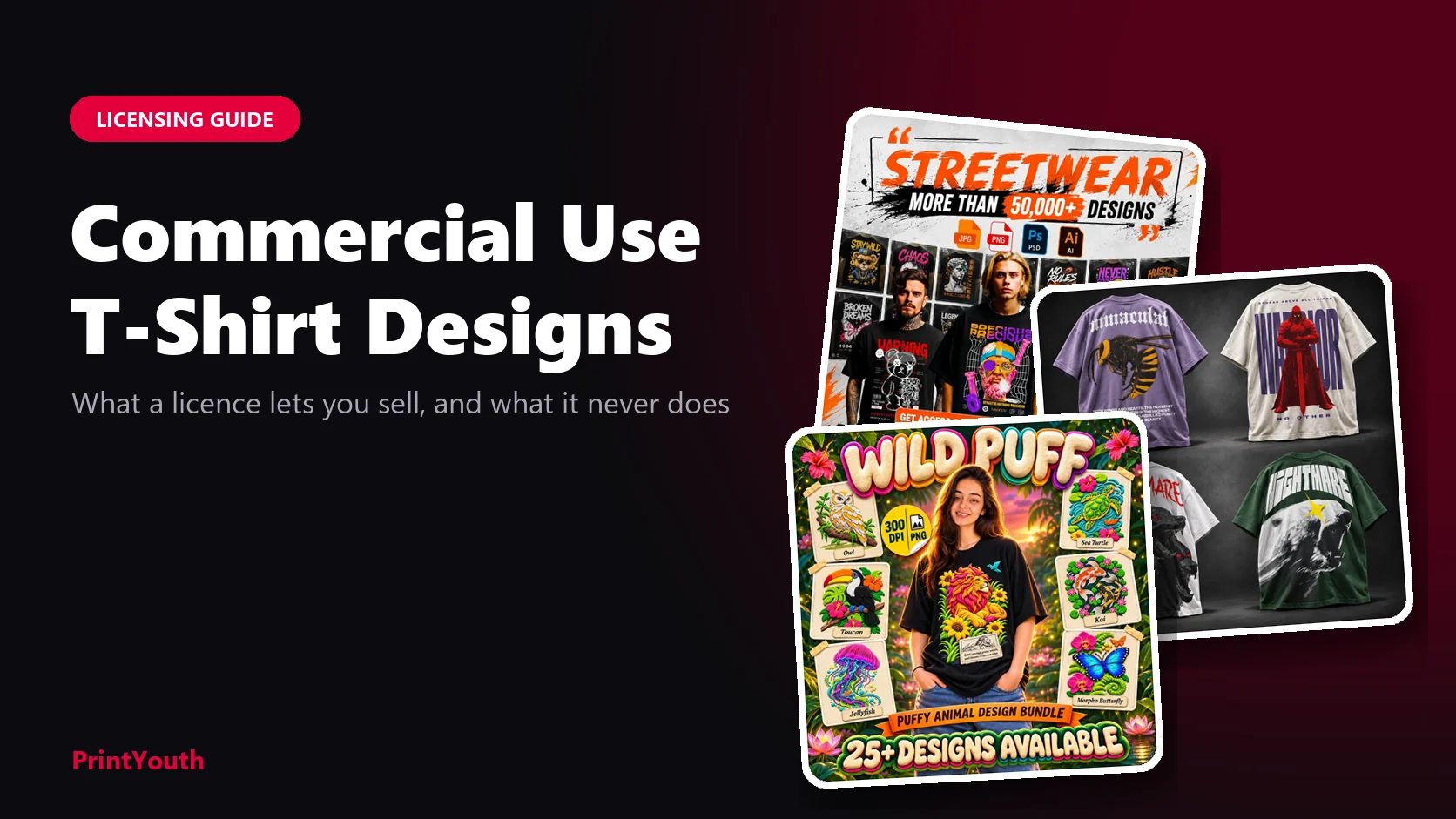
A commercial use licence for t-shirt designs lets you print the artwork on products such as t-shirts, hoodies and mugs and sell those products for profit, usually on any marketplace or your own store. It doesn't let you resell or share the design files, claim the artwork as yours, or use any brand or character the artwork resembles.
"Commercial use" is printed on almost every design pack for sale, and it means very different things depending on who wrote the licence. Some licences cap you at 500 shirts. Some exclude print-on-demand. Some come from sellers who never owned the artwork in the first place, which makes the licence worthless.
Here's what a commercial licence normally covers, the different types you'll see, and the questions to ask before you pay.
What does "commercial use" mean for t-shirt designs?
Commercial use means you may use the designs to make money, typically by printing them on products and selling those products. It's the opposite of personal use, which covers printing a shirt for yourself or a gift. For a t-shirt seller, a design without a commercial licence is unusable.
The key idea is that you're buying a right to use the artwork, not the artwork itself. The creator keeps the copyright and lets you sell what the design becomes: a printed shirt. That's why almost every licence forbids passing the files on; doing so would hand someone else the same right without paying for it.
What can you do with a commercial use t-shirt design?
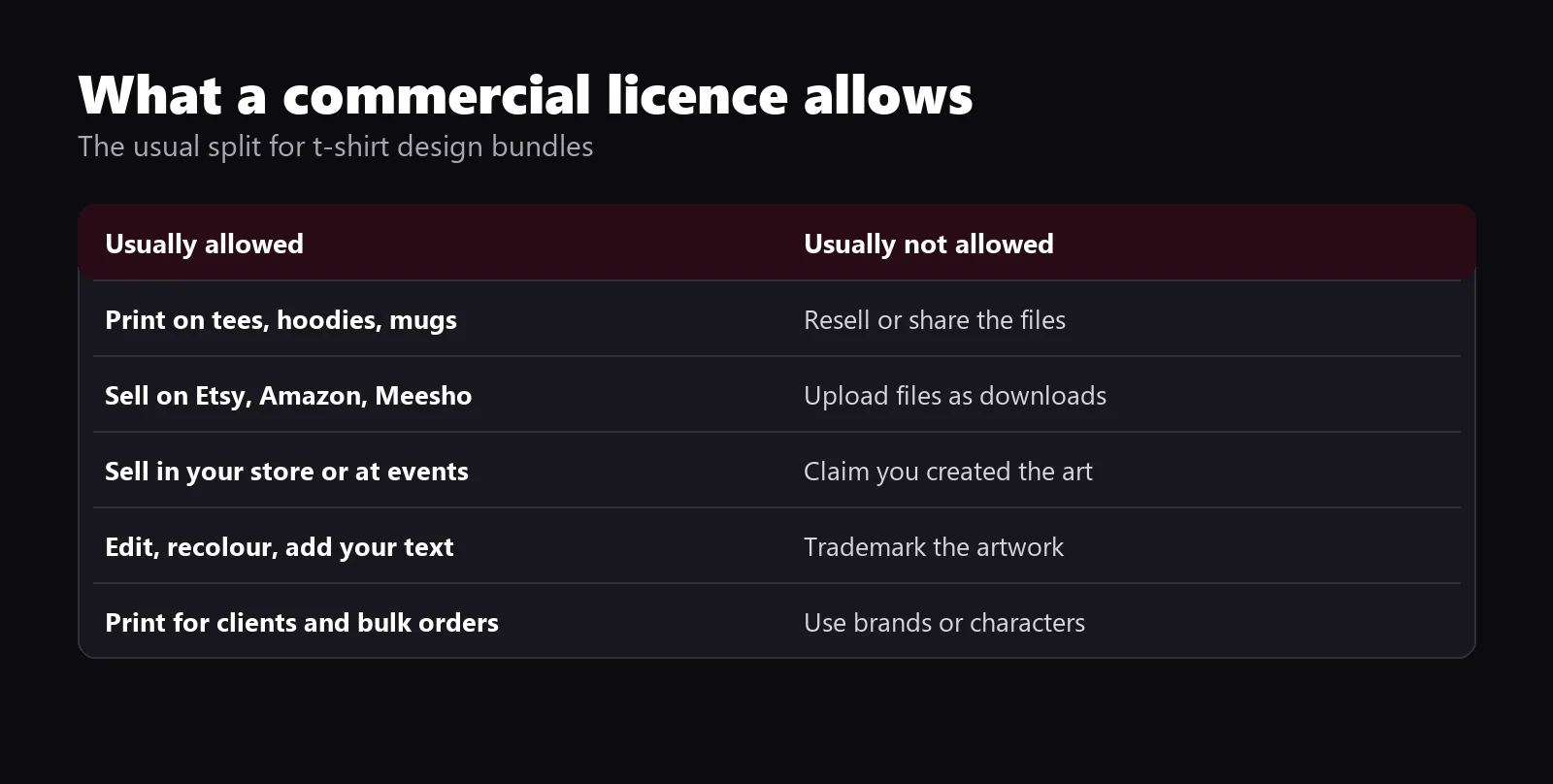
With a typical commercial licence you can print the design on t-shirts, hoodies, mugs and similar products, sell them online, at events or wholesale, list them on print-on-demand platforms, and edit, recolour or combine the artwork with your own designs. Good licences put no cap on quantity.
PrintYouth's commercial licence is a useful example because it spells each right out. It allows printing on merchandise and selling the finished products; listing on print-on-demand platforms including Merch by Amazon, Etsy, Redbubble, Printful, Printify, Spreadshirt and TeePublic; selling in your own store, at markets or wholesale; editing and combining designs; and using one bundle across unlimited products, print runs and stores, with no expiry.
| Usually allowed | Usually not allowed |
|---|---|
| Print on t-shirts, hoodies, mugs, bags | Resell or share the design files |
| Sell on Etsy, Amazon, Redbubble, Meesho | Upload files as a digital download |
| Sell in your own store or at events | Claim you created the artwork |
| Edit, recolour, add your text | Register the art as your trademark |
| Print for clients and bulk orders | Use brands or characters it resembles |
What types of design licence are there?
The common licence types are personal use, standard commercial use, commercial use with a print cap, extended or unlimited commercial use, and exclusive rights. For a t-shirt business, you want commercial use with no print cap, or an exclusive licence for signature designs.
| Licence type | What it allows | Good for a t-shirt business? |
|---|---|---|
| Personal use | Printing for yourself or gifts only | No |
| Commercial, capped | Selling up to a set number of items | Only for small tests |
| Commercial, unlimited | Selling products with no quantity limit | Yes, the usual choice |
| Extended / POD licence | Unlimited, plus print-on-demand platforms | Yes, if you use POD |
| Exclusive | Only you may use the design | For signature designs, at a much higher price |
Some stock marketplaces sell a separate "merchandise" or "t-shirt" licence on top of their standard licence, because their basic licence excludes products where the design is the main thing being sold. Read which one you're buying.
Is a commercial licence exclusive?
No, almost never. A commercial licence on a design bundle is non-exclusive: other buyers get the same designs and the same rights. That's why editing designs, adding your own text and choosing a distinct niche matters more than the files themselves.
This surprises some first-time buyers, but it's how affordable bundles work. Exclusive rights cost many times more because the creator gives up every other sale. The practical answer is to treat a bundle as raw material. Recolour it to match your range, pair a graphic with your own slogan, combine two elements, and the result stops looking like anyone else's listing.
What are the red flags in a "commercial use" bundle?
The biggest red flags are famous characters or brand logos in the previews, no licence page to read before buying, a licence hidden inside the download, unrealistic design counts at very low prices, and files delivered through Telegram or a shared Google Drive. Any one of these is a reason to walk away.
- Characters and logos in previews: a seller can't license what they don't own.
- No public licence: you should read the terms before paying, not after.
- Vague wording: "commercial use OK" with no details on quantity, platforms or reselling.
- Impossible numbers: hundreds of thousands of designs for under ₹100 usually means collected, not created.
- Shared-drive delivery: if the files are in a public Drive folder, so is your "exclusive" catalogue.
Our bundle buyer's checklist covers how to test the files themselves.
Does a commercial licence protect you from copyright claims?
A commercial licence protects you only for artwork the seller actually owns. If a design copies a character, logo or someone else's art, the licence can't give you rights to it, and the platform or rights owner can still remove your listing. Original artwork plus a clear licence is what protects you.
Keep your proof. Save the receipt, a copy of the licence as it was when you bought, and the original files. If a platform ever questions a listing, those three things settle most cases quickly. For the wider legal picture, see how to avoid copyright infringement with t-shirts.
How do you read a design licence quickly?
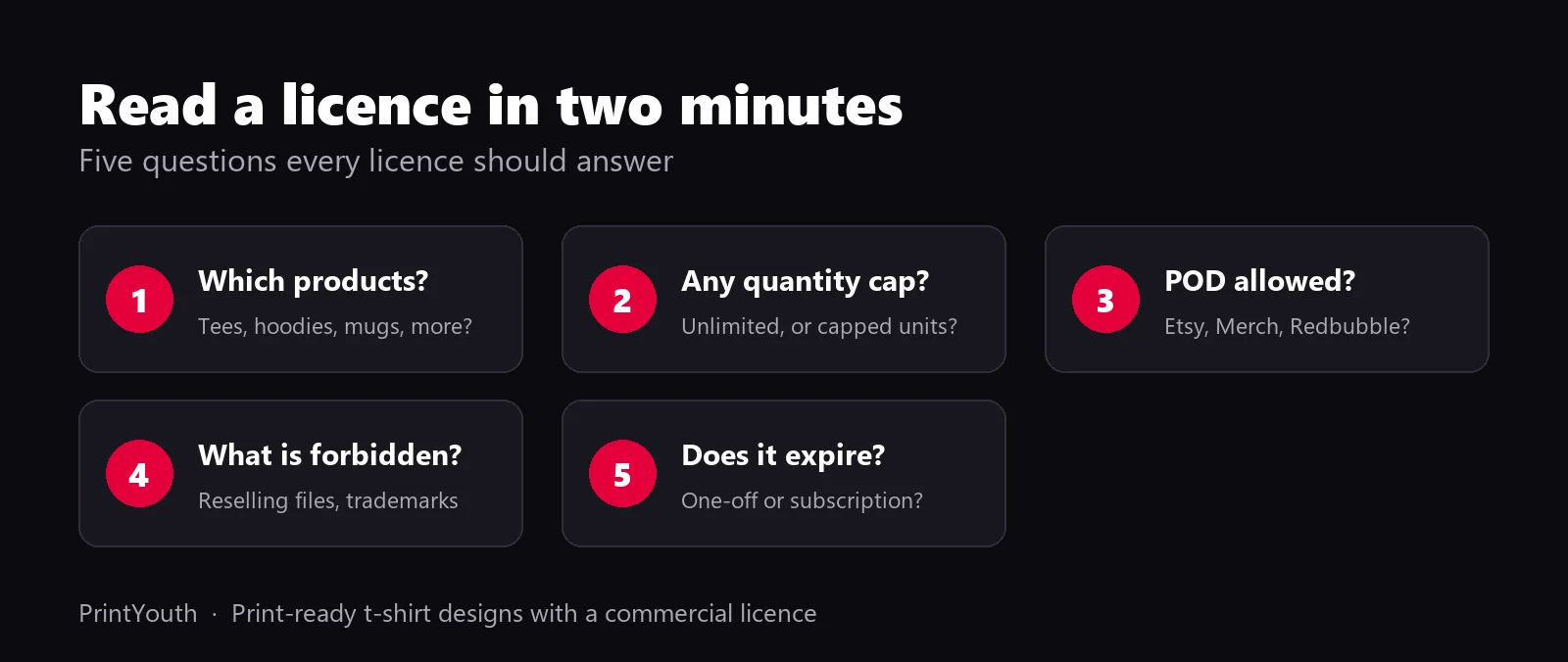
Read a design licence by checking five things: what products you may print, whether there's a quantity cap, whether print-on-demand platforms are allowed, what's forbidden, and whether it expires. If any of these is missing or unclear, ask the seller before buying.
Frequently asked questions
Can I sell t-shirts with commercial use designs on Amazon?
Yes, if the licence allows marketplaces or print-on-demand platforms, as most commercial licences do. Amazon also applies its own content rules, so avoid designs resembling brands or characters.
Is there a limit on how many shirts I can sell?
It depends on the licence. Some cap sales at a few hundred items; others, including PrintYouth's, have no limit on print runs or units sold. Check before buying.
Can I edit commercial use designs?
Usually yes. Most licences let you recolour, resize, crop and combine designs with your own artwork. You still can't sell the edited files as a design pack.
Can I use one licence for two stores?
Many licences are tied to the buyer, not a store, so one licence covers all your shops. Some limit use to one business; read the terms.
What is the difference between commercial and extended licences?
An extended licence usually removes limits in the standard commercial licence, such as print caps or exclusions for merchandise and print on demand. The names vary by seller, so compare what each one actually allows.
Can I give designs to my printer?
Yes, sending a file to your printer to make your products is normal. What you can't do is let the printer or anyone else keep and reuse the files for their own customers.
The short version
A commercial licence lets you sell what the designs become, not the designs themselves. Look for unlimited print runs, print-on-demand permission and a readable licence page, avoid packs with characters or logos, and customise the artwork so your listings are your own.
Every PrintYouth bundle carries the same commercial licence; the Whole Shop Bundle covers every pack in one purchase.
Last updated: 22 November 2026. General information, not legal advice.