INR – Indian Rupee
 EUR – Euro
 NZD – New Zealand Dollar
 PKR – Pakistani Rupee
 PHP – Philippine Peso
 BDT – Bangladeshi Taka
 LKR – Sri Lankan Rupee
 NPR – Nepalese Rupee
 MMK – Myanmar Kyat
To avoid copyright infringement with t-shirts, only print artwork you created or are licensed to use commercially, and never use characters, logos, team crests, celebrity photos, film stills or famous slogans owned by someone else. Read every design licence, change nothing into a "parody" to dodge it, and remove any listing the moment you receive a valid complaint.
Most t-shirt sellers who get into copyright trouble didn't set out to steal anything. They printed a cricket-team crest for a local match, an anime character a customer asked for, or a "free" design from a Telegram group. Then a marketplace removed the listing, held the payout, or closed the shop.
This guide is written for sellers in India, where the same international marketplace rules apply alongside Indian copyright, trademark and personality-rights law. It isn't legal advice; for a specific dispute, talk to an IP lawyer.
What counts as copyright infringement on a t-shirt?
Copyright infringement on a t-shirt means printing and selling artwork, photos, characters or text that someone else owns without their permission. Trademark infringement is the related problem of using a brand name or logo, such as a sports-team crest or fashion label, in a way that could confuse buyers.
In India, artwork is protected under the Copyright Act, 1957, and brand names and logos under the Trade Marks Act, 1999; both are administered through the government's Copyright Office and IP India. Copyright exists automatically when someone creates a work, so "it isn't registered" is not a defence. Selling abroad through Etsy, Amazon or Redbubble adds those platforms' own policies on top.
Which t-shirt designs most often get sellers in trouble?
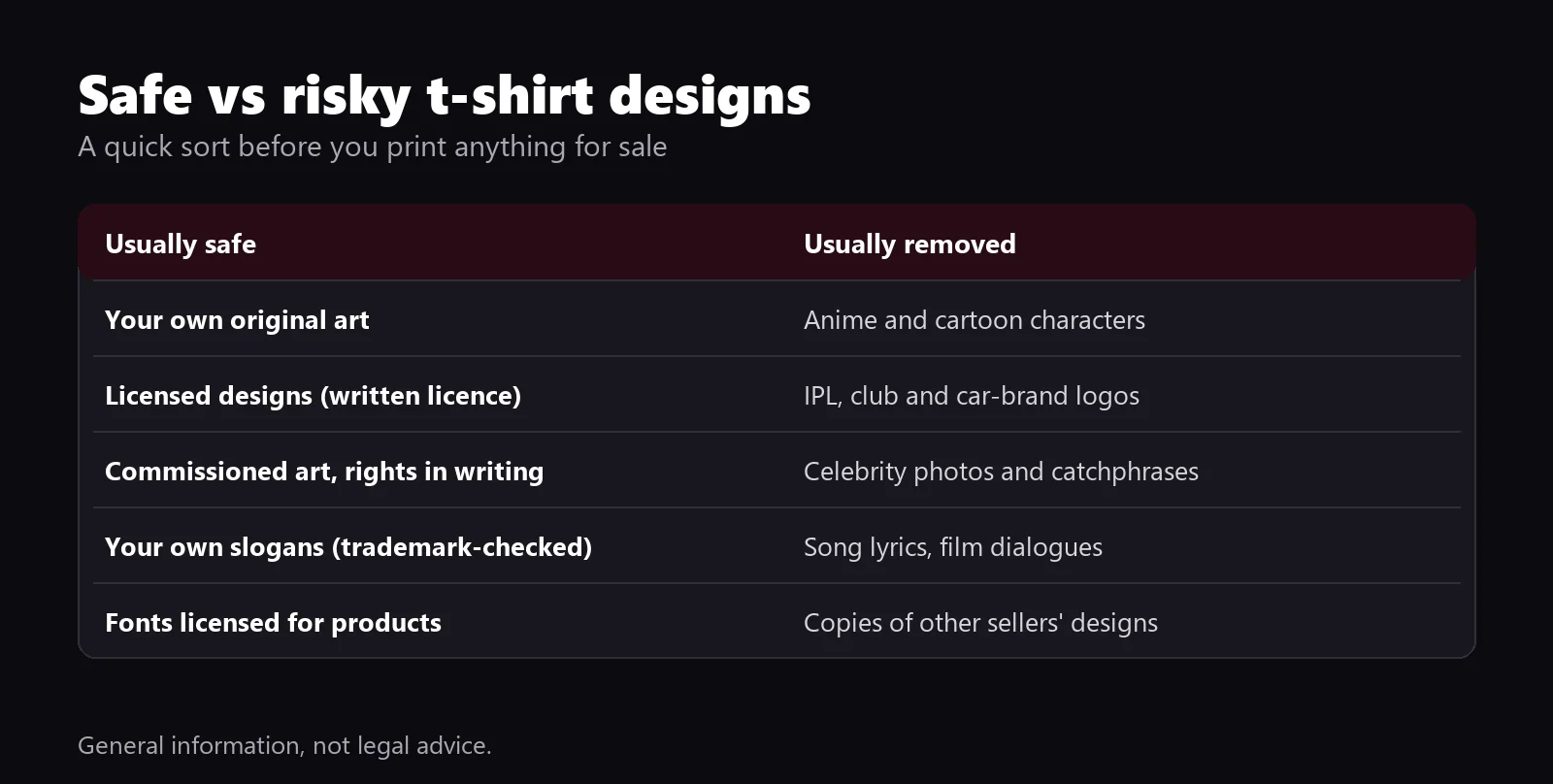
The designs that most often cause trouble are film, cartoon and anime characters; sports-team, league and car-brand logos; celebrity photos and names; famous film dialogues and song lyrics; fashion-brand monograms; and designs copied from another seller's bestsellers.
| Design type | Risk | Why |
|---|---|---|
| Anime, cartoon and film characters | High | Studios actively file takedowns |
| IPL, football club or car-brand logos | High | Registered trademarks |
| Celebrity photos, names, catchphrases | High | Personality rights, often enforced in Indian courts |
| Song lyrics and famous film dialogues | Medium to high | Copyrighted text |
| "Inspired by" copies of another seller's design | Medium | Close copies still infringe |
| Your own art or licensed designs | Low | You hold the rights or permission |
| Generic phrases and common symbols | Low | Short common phrases usually aren't protected, but check trademarks |
Celebrity rights deserve a special mention in India. The Delhi High Court has granted orders protecting the personality rights of well-known actors, including Amitabh Bachchan in 2022 and Anil Kapoor in 2023, which covered unauthorised use of their name, image and even catchphrases on merchandise. A face or a famous line on a tee is not free to use just because it's popular.
Is it legal to print fan art or parody t-shirts?
Usually not for sale. Fan art of a character is still a copy of that character, and calling a design "parody" rarely protects a seller of merchandise, because the main purpose is to sell shirts using someone else's popular work. Treat fan art as personal, not commercial.
The test that catches most sellers out is simple: would this shirt sell if you removed the character or logo? If the answer is no, the value is coming from someone else's property. That's exactly the listing rights owners look for.
Where do you get t-shirt designs that are safe to sell?
Safe sources are your own original artwork, work from a designer who transfers the rights to you in writing, and ready-made designs sold with a commercial licence that covers merchandise. Free images and Google Drive "packs" are risky unless the licence clearly allows selling printed products.
- Create it yourself: original drawings, your own photos, your own slogans.
- Commission it: get a written agreement that the rights pass to you, and confirm the designer didn't trace someone else's art.
- Buy it licensed: choose sellers who publish a readable licence before you pay.
- Check fonts: some fonts need a commercial licence for products; free-for-personal-use fonts don't cover shirts.
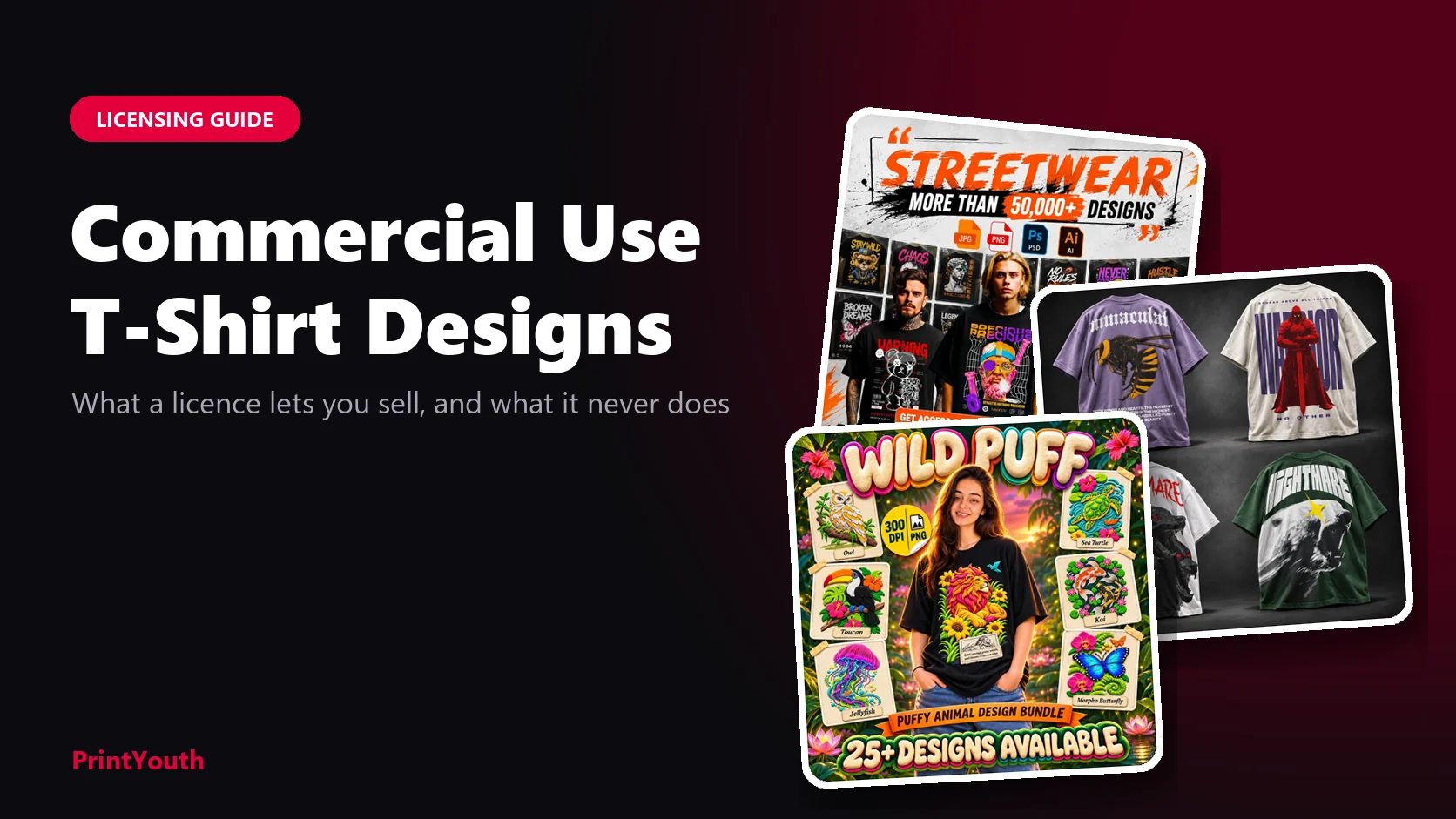
Be careful even with paid bundles. Some cheap packs are full of characters and brand logos with a "commercial use" badge on top. The seller can only license what they own. PrintYouth's licence, for example, states that it covers our artwork and gives no rights to any third-party brand, character or logo. Our guide to what a commercial licence lets you sell explains the terms to look for.
How do you check a design before you print it?
Before printing, check who created the design and what licence you hold, search for the slogan and any names in a trademark search, reverse-image search the artwork, and look for any logo, character, face or famous line. If anything belongs to a company or a person, don't sell it.
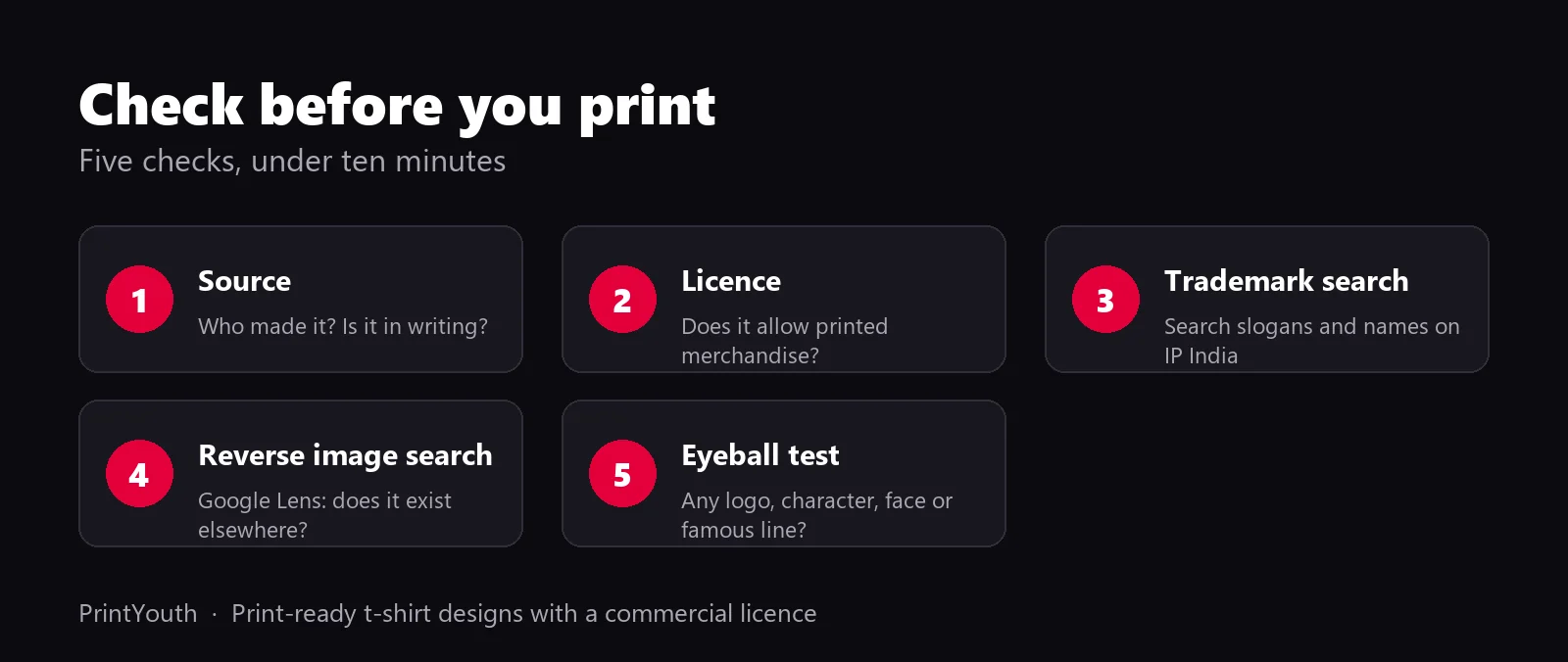
- Source: do you know who made it, and do you have it in writing?
- Licence: does it allow selling printed merchandise?
- Trademark search: search the slogan and names on IP India's public trademark search.
- Reverse image search: Google Lens shows whether the artwork appears elsewhere first.
- Eyeball test: any logo, character, real person or famous quote? If yes, remove it.
What should you do if you receive a copyright complaint?
If you receive a copyright or trademark complaint, remove the listing straight away, stop printing the design, keep records of where you got it, and reply politely through the platform's process. Don't relist it under a new title; repeat complaints are what get accounts closed.
If you believe the complaint is wrong, for example because the artwork is genuinely yours or properly licensed, most platforms have a counter-notice process. Use it with your evidence: original files, the purchase receipt and the licence. For a legal notice sent directly to you, rather than through a platform, speak to an IP lawyer before replying.
Can you protect your own t-shirt designs?
Your original designs are protected by copyright as soon as you create them. You can strengthen your position by keeping dated source files, registering important artwork with the Copyright Office, and registering your brand name as a trademark if you're building a label.
Watermark your mockups, not your print files, and keep the layered originals. If someone copies a bestseller, those files are your proof. Most marketplaces also accept takedown requests from rights owners, so the same system that protects others can protect you.
Frequently asked questions
Can I sell t-shirts with anime characters in India?
Not without a licence from the rights owner. Anime characters are copyrighted, studios do file takedowns, and marketplaces remove such listings. Original anime-style art without real characters is safer.
Can I print IPL team logos on t-shirts?
No. Team names, logos and crests are registered trademarks. Printing them for sale without an official licence risks takedowns and legal action, even for small local orders.
Is it copyright infringement to change a design by 30%?
There's no safe percentage. If the result is still recognisable as someone else's work, it can still infringe. Create original artwork or use licensed designs instead.
Can I use free images from Google on t-shirts?
No. Images found on Google belong to their creators. Use only images with a licence that allows commercial use on merchandise, or create your own.
Are short slogans protected by copyright?
Short common phrases usually aren't protected by copyright, but some are registered trademarks. Search the phrase in a trademark database before printing it for sale.
Do I need to register my t-shirt designs?
No. Copyright applies automatically when you create original work. Registration with the Copyright Office can help as evidence in a dispute, which matters for designs that sell well.
The short version
Print only what you made or are licensed to sell. Skip characters, logos, celebrities, lyrics and copies of other sellers' work, check fonts, keep your receipts, and take listings down the moment a valid complaint arrives.
For original, licensed artwork to build on, start with the Mega Typography Bundle or the Unlimited Streetwear Bundle.
Last updated: 22 November 2026. This article is general information, not legal advice.