INR – Indian Rupee
 EUR – Euro
 NZD – New Zealand Dollar
 PKR – Pakistani Rupee
 PHP – Philippine Peso
 BDT – Bangladeshi Taka
 LKR – Sri Lankan Rupee
 NPR – Nepalese Rupee
 MMK – Myanmar Kyat
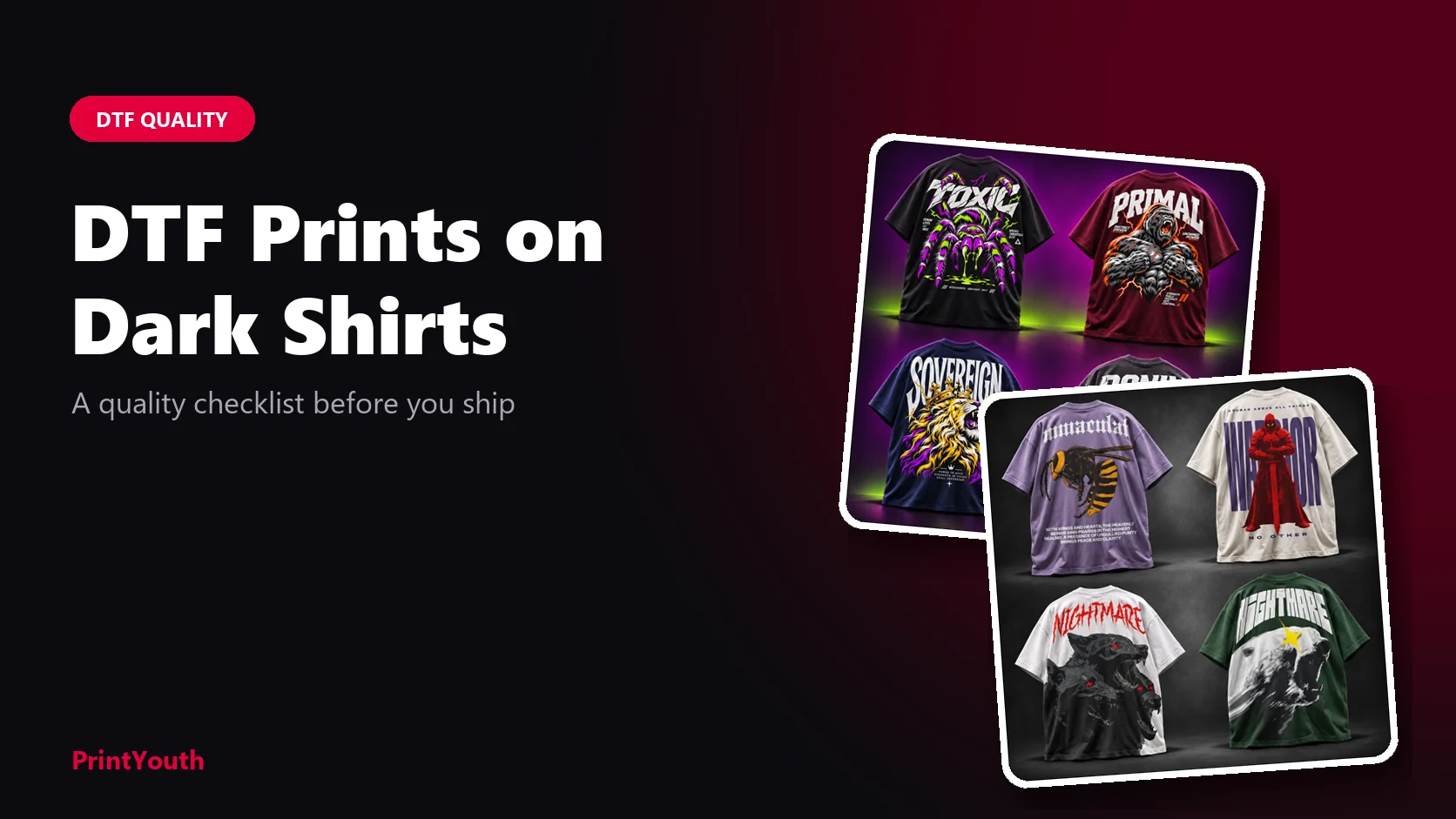
A good DTF print on a dark shirt has an opaque white layer so colours stay bright, no white halo beyond the colour edges, edges that don't lift when scratched, no cracks when the fabric is stretched, a matte or satin finish rather than plastic shine, and no fading or peeling after five inside-out washes. Check the film before pressing and test one shirt from every new batch.
Dark shirts are where DTF earns its reputation, and where customers notice every flaw. A thin white layer turns red into maroon. A misaligned white layer leaves a pale outline around the design. A print that looks perfect on delivery cracks after the third wash and comes back as a one-star review.
This is a quality checklist for DTF on black and dark garments, from the moment the film arrives to the moment you pack the shirt.
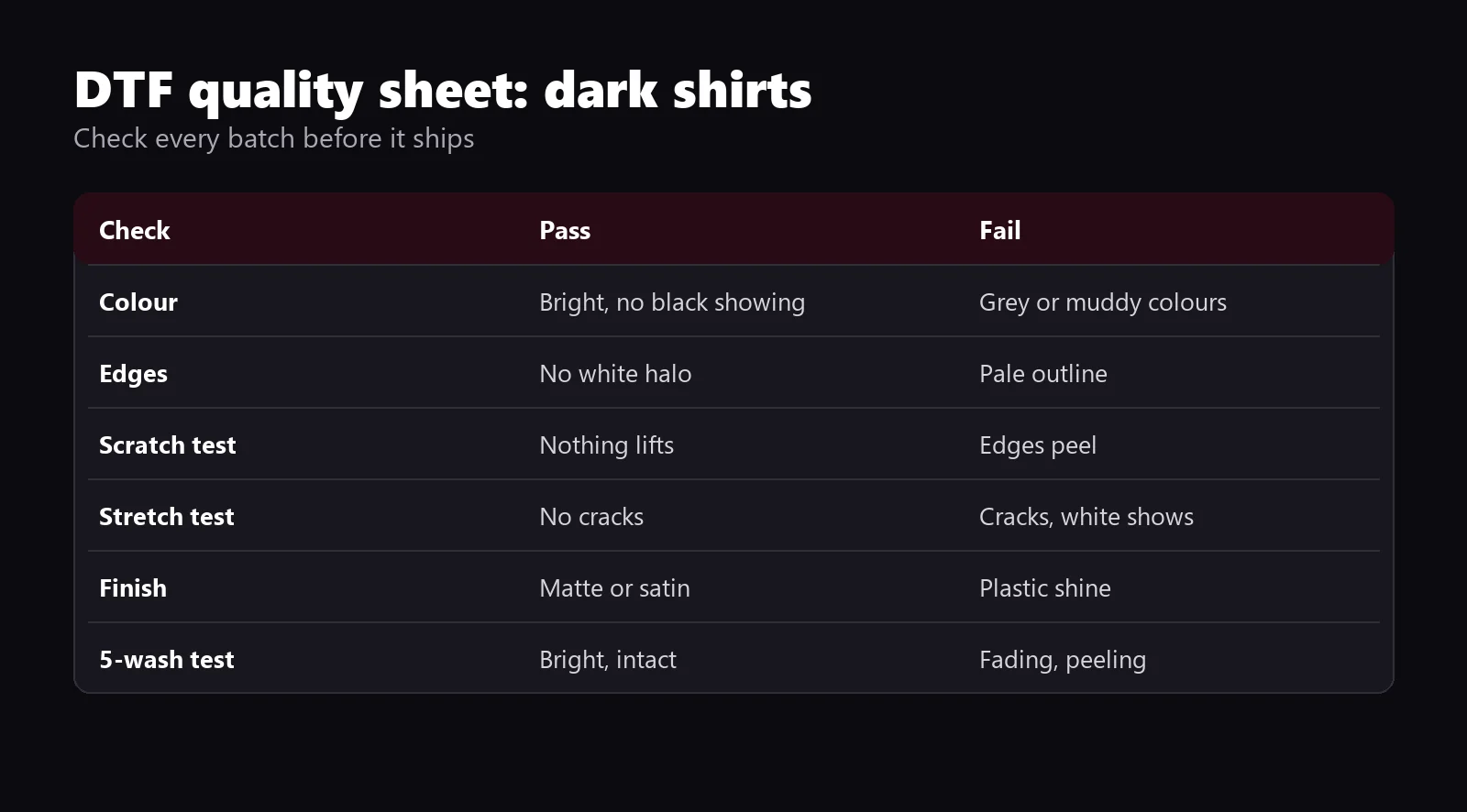
What makes a good DTF print on a dark shirt?
A good DTF print on a dark shirt has bright, accurate colours backed by an even white layer, sharp edges with no white outline, a soft hand-feel, and strong adhesion that survives stretching and washing. The black fabric should never show through the colours, and the white should never show beyond them.
The white underbase is what makes dark-shirt DTF work. It's printed under every coloured pixel so the colours sit on white instead of black. If it's too thin, colours look muddy. If it's printed slightly wider than the colour layer, it shows as a pale halo. Both are printing issues you can catch before pressing.
What should you check on the DTF film before pressing?
Before pressing, check that the white layer is solid and even under the colours, that white and colour layers line up with no visible white rim, that powder covers the whole print without clumps, and that the film has no smudges, scratches or uncured spots.
- White opacity: hold the film against a dark surface; colours should look bright, not grey.
- Registration: zoom in on edges with your phone camera; no white sticking out.
- Powder: even, fully melted, no bare patches or lumps.
- Damage: no scratches, fingerprints or smears on the ink.
- Size: measure the print against the order (for example 11 inches wide).
If you buy film from a supplier, these five checks take a minute per sheet, and they're your evidence if you need a reprint.
How do you test DTF adhesion after pressing?
Test adhesion with three quick checks once the shirt has cooled: run a fingernail firmly along the edges (nothing should lift), stretch the print gently in both directions (no cracking or white showing through), and bend the fabric back on itself (the print should flex, not split).
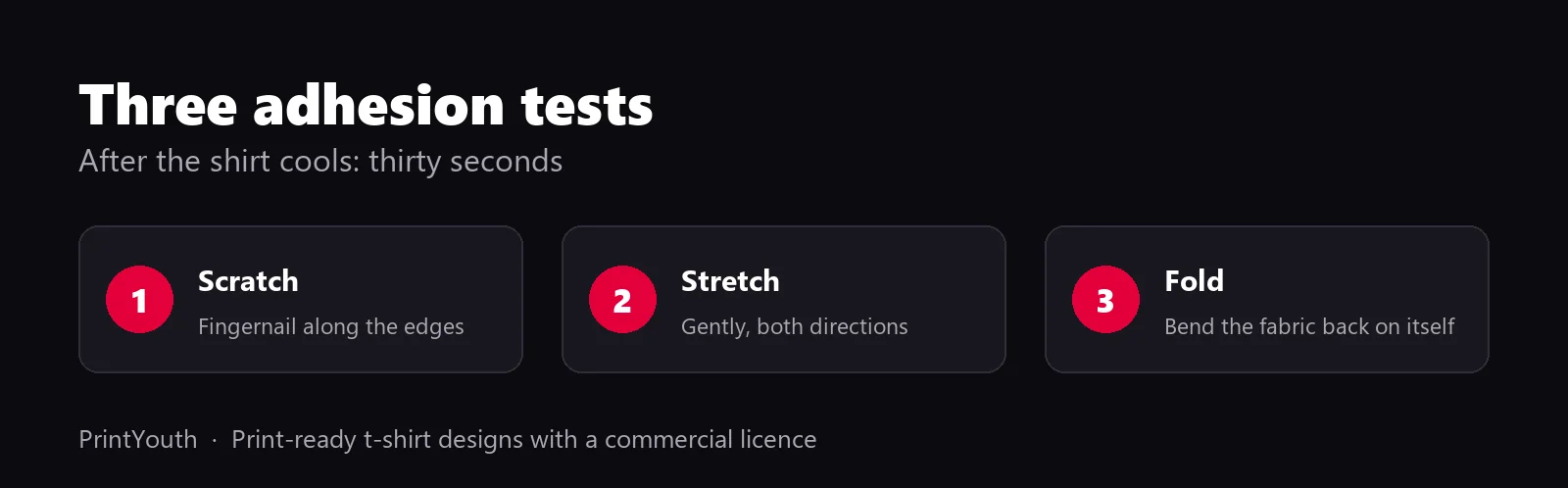
Failures here almost always trace back to pressing: too little heat, uneven pressure or a skipped second press. Our DTF heat press settings chart has the starting numbers and fixes.
How do you run a DTF wash test?
Run a wash test on one shirt from every new design, film supplier or press setting: wash it inside out in cold water on a normal cycle five times, air dry or tumble dry low, and inspect after each wash for fading, cracking, peeling edges and stiffness. A good DTF print should look nearly the same after five washes.
| After wash | Pass | Fail |
|---|---|---|
| 1 | No change | Any edge lifting |
| 3 | Slight softening | Cracks or visible fading |
| 5 | Colours still bright, edges intact | Peeling, cracking, pale patches |
Keep the test shirt. Write the date, film supplier and press settings on the label. When a customer complains months later, you'll know whether it's a production problem or a washing one.
Why does DTF look shiny or plasticky on dark shirts?
DTF looks shiny when the print is pressed without a second press, when too much glue powder is used, or when the design has large solid areas. A second press with parchment or a textured cover sheet usually gives a matte finish; halftone artwork reduces the plastic look.
The design side matters as much as the press. A big solid black-and-red block becomes a thick rubbery patch on a dark shirt. The same artwork with halftone shading and knocked-out blacks prints lighter and lets the fabric breathe. Our guide to black t-shirt designs that print well covers the knock-out technique.
What care instructions should you give customers?
Tell customers to wash DTF-printed shirts inside out in cold water, avoid bleach and fabric softener, tumble dry low or line dry, never iron directly on the print, and wait 24 hours before the first wash. A small care card in the parcel prevents many complaints.
- Wait 24 hours before the first wash.
- Turn the shirt inside out.
- Cold or lukewarm water, mild detergent.
- No bleach, no softener.
- Line dry or low heat; don't iron the print.
What should a DTF QC process look like for a small shop?
A small shop's DTF QC process can be four steps: inspect every film sheet before pressing, do a scratch and stretch test on every pressed shirt, wash-test one shirt per new design or supplier, and pack each shirt with a care card. It adds minutes per batch and saves reprints and refunds.
Frequently asked questions
Why do DTF colours look dull on black shirts?
Usually the white underbase is too thin or uneven. Ask your supplier for a stronger white layer, and check the film against a dark surface before pressing.
What causes a white outline around DTF prints?
The white layer is printed slightly larger than the colour layer or misaligned. Some printers add a small "choke" to the white to prevent this; check edges closely before pressing.
How many washes should a DTF print last?
A properly pressed DTF print on cotton should last dozens of washes when washed inside out in cold water. Test five washes on one sample shirt per batch.
How do I know if my DTF print is pressed properly?
After cooling, scratch the edges, stretch the print and fold the fabric. Nothing should lift, crack or show white through the colours.
Is DTF good on black polyester sports shirts?
Yes, at a lower temperature, around 140–150 °C. Watch for dye migration on coloured polyester, which can tint the white layer.
Should I include care instructions with DTF shirts?
Yes. A care card asking for cold, inside-out washing and no ironing on the print prevents most early fading and cracking complaints.
The short version
Check the film (white opacity, registration, powder), press correctly with a second press, scratch-stretch-fold every shirt, wash-test one per batch, and ship with a care card. Halftone artwork and knocked-out blacks make dark-shirt prints softer and more durable.
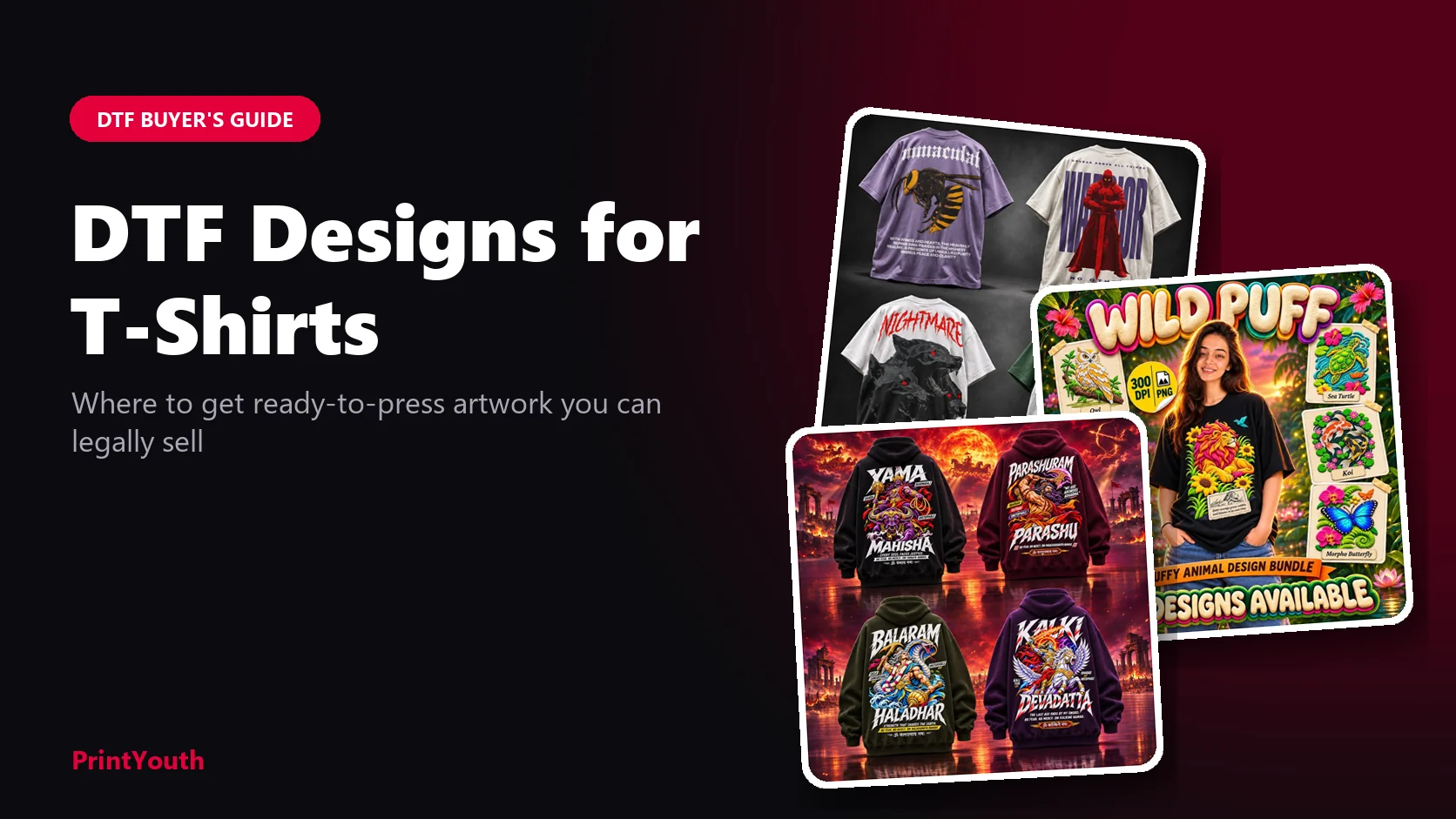
DTF-ready artwork made for dark shirts: the Wild Warrior V2 pack and the Unlimited Streetwear Bundle.
Last updated: 22 November 2026.